
The U.S. Just Hit Its Highest Wildfire Alert Level -
And Fire Is Only Part of the Danger
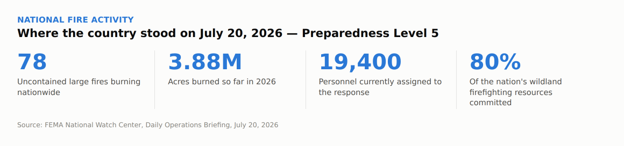
For the first time this year, federal fire officials have raised the National Preparedness Level for wildfires to 5, the highest of five tiers, reserved for when fire activity is so extreme that 80 percent of the nation’s wild land firefighting resources are already committed. As of July 20, FEMA’s National Watch Center was tracking 78 uncontained large wildfires burning across the country, with 9 new large fires breaking out in a single 24-hour period and more than 3.88 million acres already burned this year. Nearly 19,400 personnel are currently assigned to the response, supported by 25 complex incident management teams. (FEMA National Watch Center, Daily Operations Briefing, July 20, 2026)
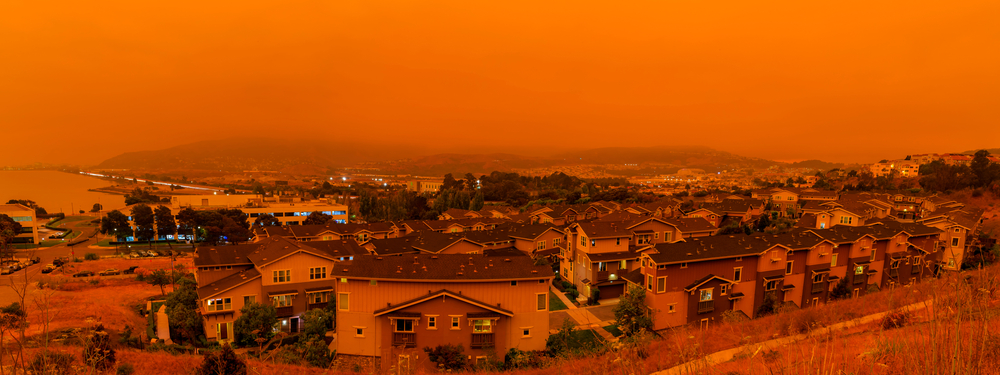
Two of the most severe fires burning right now show what that strain looks like on the ground. In Washington, a lightning-sparked fire near Nespelem on the Colville Reservation, the Kaiser Canyon Fire, has grown to more than 60,000 acres in less than a week with 0 percent containment, driven by 90-degree heat and single-digit humidity. It has surrounded the town on three sides, destroyed at least 13 homes, and forced roughly 1,000 people to evacuate. In Colorado, the Aspen Acres Fire has burned more than 100,400 acres across Custer and Pueblo counties and destroyed 356 homes and 559 other structures. It’s part of a cluster of large Colorado fires, including the Gold Mountain and Willow fires, that together have caused at least one death, injured dozens of people, and forced nearly 2,800 mandatory evacuations.
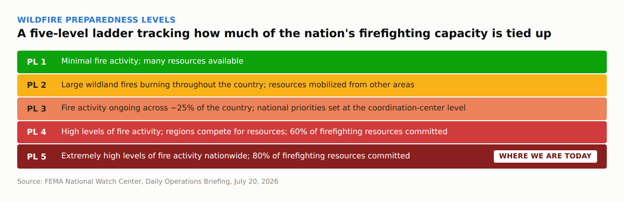
Preparedness Level 5 is the top rung of a five-level federal ladder that tracks how much of the country’s firefighting capacity is tied up at once. At Level 3, fire activity across roughly a quarter of the country is enough for the National Interagency Coordination Center to start setting national priorities. At Level 4, 60 percent of the nation’s wildland firefighting resources are committed, and regions start competing for crews. At Level 5 where the country sits now the number climbs to 80 percent, and as NPR reported this week, crews and equipment “may be harder to come by for new or growing wildfires,” no matter where they break out. The Pacific Northwest’s own coordination center is independently at Level 5, and the Rocky Mountain and Eastern regions are both at Level 4 this means the regions with the least fire activity right now are also the ones most likely to be asked to send help elsewhere.
The same conditions pushing the country toward Level 5 are the ones we wrote about last month in Heat Is the Deadly Weather Event Nobody Stops For: the extreme, record-breaking heat gripping much of the West and Plains this summer is also what’s turning landscapes into fuel. The Kaiser Canyon Fire exploded under 90-degree heat and single-digit humidity; Colorado’s fires have spread through the same high-pressure heat dome that pushed Salt Lake City to an all-time record 109°F. Heat isn’t just a health emergency running in parallel to wildfire season it is one of the conditions driving it.
And even as domestic fires strain the country’s firefighting resources, the smoke crisis we covered in When Heat and Smoke Collide hasn’t let up. Smoke drifting down from more than 850 wildfires burning in Ontario, Canada triggered air quality alerts across 17 states and Washington, D.C. this month and gave Detroit its worst air quality reading since the city began monitoring in 1999. This wildfire season isn’t just testing the country’s ability to fight fire, it is stacking fire, heat, and smoke on top of each other, often in the same places, at the same time.
For health systems, that stacking matters. Evacuations don’t pause for patients who rely on refrigerated medication, home oxygen, or dialysis; and when 80 percent of the nation’s firefighting resources are already committed, mutual aid and outside support may be slower to arrive than usual. At the same time, the N95/KN95 masks, HEPA air purifiers, and respiratory care supplies that communities need for wildfire smoke are being pulled toward heat-related ER surges and fire-zone evacuations simultaneously, not one at a time, testing supply chains built to respond to a single crisis at once.
Health systems, emergency planners, and the communities they serve can take several steps such as fire, heat, and smoke risks continue to overlap this summer. The first is to track fire, heat, and air quality together rather than separately: a Level 5 designation, a heat advisory, and an AQI alert can all be true in the same region at the same time, so plans need to account for the overlap, not just each hazard on its own. Patients with chronic conditions should have an up-to-date go-bag that includes a two-week supply of medications, copies of prescriptions, chargers for medical devices, and a properly fitted N95 or KN95, since evacuation orders during Level 5 conditions can arrive with very little notice.
Facilities in or near fire-prone areas should also confirm their evacuation and continuity-of-operations plans, particularly for oxygen-dependent, dialysis, and other high-acuity patients who can’t easily relocate and should coordinate early with regional healthcare coalitions and emergency management partners when national resources are this stretched, local and regional mutual aid becomes the first line of response, not the backup. Most importantly, no one should wait for the next Level 5 declaration to prepare. As this summer shows, fire, heat, and smoke are no longer separate seasons; they’re overlapping risks that call for one coordinated plan.
This is the third piece in our summer series on extreme weather and public health. Read the first two: Heat Is the Deadly Weather Event Nobody Stops For and When Heat and Smoke Collide: Creating Hazardous Air We Are Breathing In. Visit our Community Disaster Resilience Tool (CDRT) to help understand the risks of communities facing overlapping vulnerabilities, healthcare infrastructure, and exposed hazards.
About Healthcare Ready
For almost two decades, Healthcare Ready is a trusted 501(c)3 nonprofit that serves as a public-private nexus to prevent patient care disruptions amid crises. We do this by forging partnerships and serving as the linkage point between the healthcare supply chain and government. By working with supply chain stakeholders, emergency management, patient advocacy groups, and community-based organizations, we help safeguard patients before, during, and after crises by leveraging our core capabilities. Healthcare Ready is a member of The Fedcap Group.
To request the help of our Emergency Operations Center, contact us at alerts@healthcareready.org.
Sign up here.to receive email notifications from Healthcare Ready