
When Heat and Smoke Collide: Creating Hazardous Air We Are Breathing In
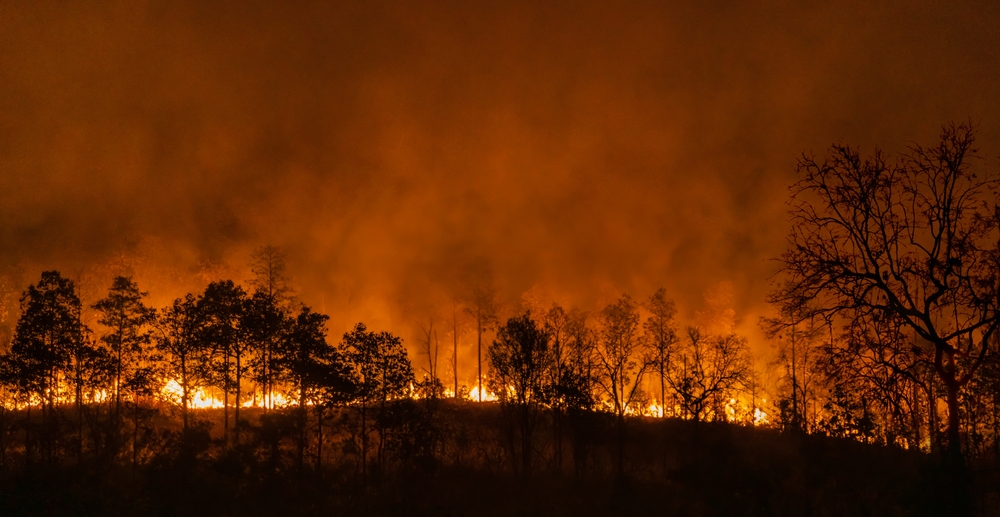
This week, smoke from more than 850 active fires in Ontario, Canada, has spread across at least 17 states and Washington, D.C.—from Minnesota to Virginia—triggering air quality alerts for tens of millions of Americans. In Detroit, the air quality index hit 874 at one monitor on Thursday, July 16 – the worst reading since the city began tracking air quality in 1999, and for a time the worst air quality of any major city in the world. New York City is also under an alert this week, though conditions there remain milder than the region’s last major smoke event, in June 2023, when the AQI spikes above 480 and turned the sky orange. Forecasters expect some relief by the weekend, when rain moving through the region is expected to wash the smoke particulate out of the air, what meteorologists have taken to calling “dirty rain.”
The smoke is arriving alongside a punishing heat wave. Phoenix reached 115 degrees, Salt Lake City hit an all-time record 109 degrees on July 13, its hottest day in 152 years of record-keeping, and communities across the upper Midwest faced dangerous heat conditions.
Extreme heat is the nation’s deadliest weather-related hazard. Heat-related deaths have risen sharply in recent years. From 2016 to 2023, the U.S. heat-related mortality rate increased by roughly 17% from 2016 to 2023. In 2023, heat was listed as an underlying or contributing cause in 2,325 U.S. deaths—the highest annual total recorded in a recent national analysis and more than double the number reported in 1999. The same pattern is seen in other parts of the globe: more than 61,000 heat-related deaths are estimated to have occurred across Europe in the summer of 2022, with that number rising to more than 71,000 the following year, with most deaths occurring during just two, weeks-long stretches of extreme heat.
The combination of extreme heat and smoke is especially dangerous for young children whose developing lungs and bodies are more susceptible to heat and smoke-related illnesses. Children breathe faster than adults, taking in more of whatever is in the air, including fine particulate matter—like PM 2.5—and other toxic pollutants carried long distances in wildfire smoke. Wildfire smoke plumes also travel long-distances—the result of what we’re seeing today in many states across the U.S.
For parents, that means checking a local air quality app before sending kids outside, running a HEPA air purifier at home if one is available, and moving playtime indoors once the AQI crosses into the unhealthy range. The challenge, however, is that not all buildings have the infrastructure necessary to ensure proper cooling and air filtration, indoors. A 2020 federal report found that about 41 percent of school districts need to update or replace HVAC systems in at least half their schools, roughly 36,000 schools nationwide. The districts with the oldest ventilation tend to serve the highest share of low-income students and students of color.
Steps schools, daycares, camps, and other child-serving facilities can take to protect the air children breathe.
Building owners and operators of schools, daycares, camps, and other child-serving facilities can take the following measures to protect the health and safety of children during wildfire smoke events.
- Track the air, and have a threshold for acting on it. Operators should monitor the local air quality index (AQI) and set clear cutoffs in advance that determine the AQI level at which outdoor play moves indoors, and the level at which it stops altogether. Decide this before a smoke event, and ensure all staff are trained on relevant protocol for taking action.
- Upgrade what the building systems where possible. Central HVAC systems fitted with MERV-13 filters catch far more fine particulate matter than the older filters still running in many school and childcare buildings. Where a full upgrade isn’t realistic yet, portable HEPA air purifiers, usually $200 to $800 per unit, can noticeably improve the air in a single classroom or nap room while a facility saves toward the bigger project. Operators who can’t yet treat the whole building can designate one well-sealed, well-filtered clean-air room and move children there when the index climbs.
- Keep a supply of high-filtration masks on hand fitted for children and staff. For children with underlying conditions like asthma, an inhaler won’t be enough on a bad air day; a properly sized KN95 or N95 is necessary to keep smoke out of lungs that are already compromised. Facilities should stock masks sized for children and know which kids in their care will need them first. New York City started handing out free KN95s at libraries and firehouses this week for exactly this reason.
- Put it in writing. A short smoke-response plan—who checks the AQI, who decides to move activities, where the purifiers go, which children need masks, how families get notified—turns all of the above from good intentions into something staff can actually execute on a Tuesday morning when the index doubles overnight.
About Healthcare Ready
For almost two decades, Healthcare Ready is a trusted 501(c)3 nonprofit that serves as a public-private nexus to prevent patient care disruptions amid crises. We do this by forging partnerships and serving as the linkage point between the healthcare supply chain and government. By working with supply chain stakeholders, emergency management, patient advocacy groups, and community-based organizations, we help safeguard patients before, during, and after crises by leveraging our core capabilities. Healthcare Ready is a member of The Fedcap Group.
To request the help of our Emergency Operations Center, contact us at alerts@healthcareready.org.
Sign up here.to receive email notifications from Healthcare Ready